Books have always been more than entertainment. They are registered thoughts and evolution of thoughts, they are nostalgia and they are healing. in formal terms, they are, culture, history, imagination, and disagreement. Through literature, societies explore ideas that challenge norms, question authority, and give voice to experiences outside the mainstream.
This is why book banning—whether formal or informal—has always been a deeply contested issue. At its core, it raises a fundamental question: what happens to a society when certain ideas are removed from public access?
A couple of months ago, a Nigerian mother took to Tiktok to complain about a disturbing passage of animal abuse she found in a curriculum text of her son, who happens to be under the age of seven. She went to TikTok because she had no other form of redress. It caused a public outcry about who was to be held responsible – the teachers, the education board, age suitability, et al.
It is the same familiar concern about appropriateness and culture, which, in the real sense, can’t be discussed separately. As we know from the adage ‘one man’s meat is another man’s poison’, the difference in opinion is emerging again.
When Safeguarding Becomes Censorship
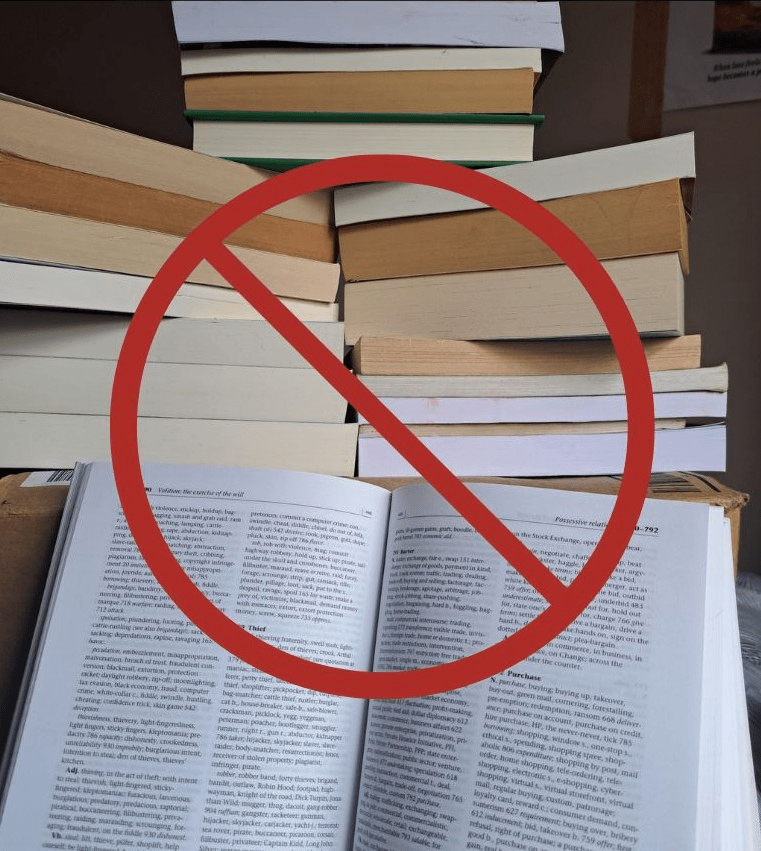
The American Library Association (ALA) reported a record number of book bans in 2025, amounting to roughly 5,668 books.
Late last year, a secondary school in Greater Manchester underwent something similar, and over a hundred books were ‘purged’ from their library. There, the ‘purge’ began with a teacher’s objection to a book titled: Men Who Hate Women by Laura Bates, a non-fiction book which exposes global misogynist networks and examines how extremist ideas spread from online communities to mainstream society.
Unfortunately, some of these books explore topics we still struggle with, topics that make a lot of people uncomfortable to discuss, i.e., race, equality, discrimination, mental health, colourism, memory loss, LQBTQ+ identities and much more.
We can’t grow by assimilation, but by absorption.
More Than Entertainment
Books have always been more than entertainment. They are recorded thoughts and the evolution of ideas, and hold the discovery of cultures, which is most often told by a survivor, not necessarily by a conqueror. We’ve learned from the course of history that literature is a divisive tool in challenging norms, questioning authority and giving voice to experiences beyond our corner of the world.
Literature Is Not Agreement
A book’s greatest achievement is its ability to expose readers to perspectives they never imagined. A book does not need to be comfortable to be valuable. Reading is not simply about affirmation. It is also about exploration.
When access to books becomes dependent on whether someone agrees with their content, literature ceases to be a tool for mental growth; it becomes a tool for cultural ignorance and the erasure of vital perspectives.
We can’t grow by assimilation but by absorption.
The purpose of literature is to mentor and challenge prevailing notions about politics, religion, identity, morality, class, and culture to provoke debate. In other words, they unsettle assumptions.
When Books Disappear
What happens when books disappear? Opportunities are discouraged, limited or erased.
- Opportunities to have alternative viewpoints are limited.
- Cultural and historical perspectives are reduced.
- Diverse cultural experiences are reduced or prohibited.
- Writers from marginalised backgrounds’ voices are silenced
- Complex discussions about real-world issues are avoided.
One of the important roles of literature is to reflect difference; therefore, a society exposed only to ideas that are considered safe, agreeable, or uncontroversial risks becoming intellectually fragile.
A healthy society is not defined by the absence of disagreement but by its ability to examine it. To examine, in this context, is to have a wider knowledge, and it can’t be performed in a vacuum.
Impact on Young Readers
The Greater Manchester case highlights another often-overlooked reality.
Many young people, particularly those who are neurodivergent, socially anxious, grief, domestic violence, religious differences, ethnic tension, family conflict or struggling with aspects of their identity, find refuge in libraries. Books often provide language for experiences they have not yet learned how to express.
Stories allow young readers to explore difficult subjects indirectly and safely.
A teenager reading about grief is not being harmed by the discussions of grief.
A teenager reading about ethnic or religious tension is not being harmed by discussions of history and society.
Often, they find understanding.
In societies as diverse as Nigeria, access to a wide range of books builds understanding of the different backgrounds, cultures, and religions.
Let books speak. They only need to be read.
Risk of Self-Censorship
Curation supports access while providing structure. Censorship limits access based on ideological disagreement, i.e., libraries curate, and people via authoritative bodies restrict.
No library can stock every book ever published, but they support access. Censorship occurs after, and not because, the book is deemed unsuitable for the intended audience, but because they express a politically inconvenient idea or other ideas that people dislike or disagree with.
The most troubling consequence of cases like this is that the books may never be purchased. It is effectively insidious because it is covert – it operates quietly without public scrutiny, and books disappear before anyone notices.
When librarians see colleagues investigated, disciplined, or effectively driven from their profession over collection decisions, they begin to avoid certain books altogether.
Let Books Speak
The debate over book banning is not ultimately about books. It is about what kind of society we want to build.
- Do we trust people to engage critically with ideas?
- Do we believe young people can think, question, and learn?
- Do we value intellectual freedom even when it makes us uncomfortable?
The answer should matter to everyone, regardless of political views.
Protecting access to books does not mean endorsing every idea contained within them.
It means recognising that ideas should be met with discussion rather than disappearance.
Because when books are removed, it is not only stories that vanish. It is opportunities for understanding, empathy and growth.
Literature does not need to be agreed with to be valuable.
Literature thrives on the diversity of voice, experience, and opinion. When certain ideas are removed from circulation, the literary landscape becomes less representative of the world it seeks to describe.
Let books speak. They only need to be read.